
Steve Golden, Solutions Architect, Mission Solutions
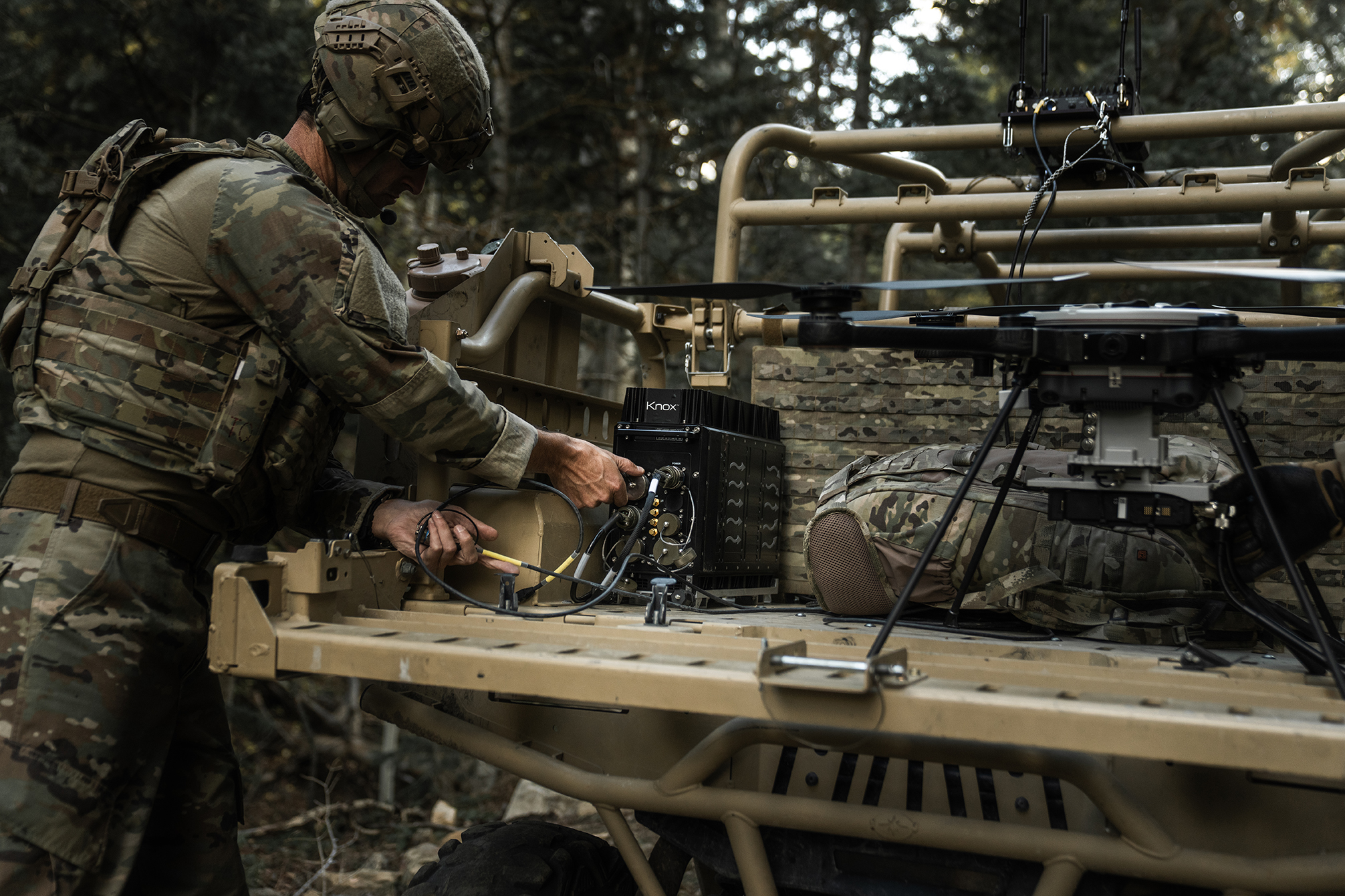
Counter-UAS and autonomous defense systems are only getting more demanding. The threats are faster, smaller, cheaper and harder to sort in real time. At the same time, operators are being asked to pull in more feeds, process more data and make decisions faster than ever. That is exactly why edge compute matters.
This isn’t just a conversation about adding more sensors or automating one piece of the chain. It’s about what happens when detection, classification, fusion and response all have to happen in seconds, not minutes. Recent Army counter-drone testing has highlighted the value of linking sensors, effectors and command-and-control systems to shorten the sensor-to-shooter timeline and reduce cognitive load. The broader defense conversation is moving the same way, with more AI capabilities pushed to the edge and more emphasis on supervised autonomy.
Counter-UAS is a speed problem first
A lot of counter-UAS discussions still focus on the visible part of the mission, which is the interceptor, the jammer or the effect. But the real problem usually starts earlier. A drone appears. Multiple sensors pick it up. Data comes in from different sources. Someone has to determine whether it is real, whether it is hostile and what should happen next.
That sounds manageable on paper. It is much harder in the field, especially when the air picture is cluttered and the timeline is compressed. The faster the threat moves, the less useful a slow processing chain becomes. If data has to travel back for processing before an operator gets a usable answer, you are already losing time. In counter-UAS, that delay matters.
That is why edge compute is so important. It keeps processing closer to the sensor and closer to the decision-maker. It helps teams fuse data faster, classify objects sooner and move from detection to response with less friction. In other words, it gives operators a better shot at acting before a threat slips through.
Autonomous defense only works if it can think locally
Autonomous defense is often framed as a software story. It’s easy to talk about algorithms, autonomy stacks and AI-enabled workflows. But none of that matters if the underlying hardware can’t process data where the mission is happening.
Defense organizations are already clear on this point. AFRL is focused on pushing AI capabilities to the edge, especially as autonomy becomes more important in contested environments. That push also comes with a clear expectation that humans remain in supervision, not buried under a flood of raw data and manual tasks. In practice, that means the system has to do more of the heavy lifting locally so the human can focus on judgment.
For counter-UAS and autonomous defense, local processing is what makes the rest of the system usable. It helps filter noise, correlate inputs, run models, cue the next action and present something meaningful to the operator without waiting on constant reachback. That is especially important in contested or bandwidth-constrained environments where connectivity may be degraded, intermittent or simply too slow for the mission window.
Autonomy isn’t just about making machines smarter. It is about making the full system more responsive. Edge compute is what helps get you there.
Open architecture is not enough by itself
Open architecture is the right direction. It supports integration, makes upgrades easier and helps avoid getting locked into one path. But open architecture does not solve the mission by itself.
A system can be modular on paper and still struggle in practice if the compute layer cannot handle the workload. Counter-UAS and autonomous defense rely on real-time or near-real-time processing, distributed fusion, low latency and interoperability across multiple systems. That raises the bar for the hardware sitting underneath the software. The architecture has to support decentralized execution, rapid data movement and the processing demands that come with AI and automation.
That is where a lot of organizations get stuck. They invest in the promise of open systems, then realize the actual environment still demands rugged, mission-ready processing at the edge. The takeaway is simple: open architecture helps you integrate faster, but only edge compute helps you act faster.
Knox brings edge compute where the mission needs it
This is where Knox fits.
The Knox family is built to deliver rugged, high-performance computing at the edge, where counter-UAS and autonomous defense systems actually need it. It’s SOSA-aligned, based on 3U OpenVPX architecture and designed to run critical applications, manage diverse data flows and support cloud-native workloads, AI/ML models and mission applications. Ultra I&C also positions Knox to support sensor fusion, command software and other edge workloads across air, land and maritime environments.
That matters because counter-UAS isn’t a single-function mission. It’s a processing problem, a fusion problem and a timing problem. Knox is built to help solve all three. It gives teams the compute backbone to run modern mission applications closer to the point of need, without depending on traditional infrastructure that may not be available when and where it counts.
Just as important, Knox supports the kind of modular, standards-aligned environment defense programs are pushing toward. That means teams can build for today’s mission while leaving room for tomorrow’s sensors, software and autonomy stack.
Turning speed into advantage
Counter-UAS and autonomous defense are raising the demand on every part of the mission stack. More data. More speed. More automation. Less tolerance for delay.
That is why edge compute matters. It helps move processing closer to the fight, shortens the path from detection to action and gives operators a system that can keep up with the mission instead of slowing it down. And if that system also needs to support open architecture, evolving mission software and AI-enabled workflows, the compute layer matters even more.
Knox is built for exactly that environment. When counter-UAS and autonomous defense demand faster processing, tighter integration and rugged performance at the point of need, Knox helps turn edge compute into operational advantage.